
Romans 8:1-11
What were you doing 25 years ago? Where were you? What was your faith like? What were your hopes and dreams for your faith?
Part I
It was a quarter of a century after the crucifixion, resurrection and ascension of Jesus. A lot had taken place in the early life of the church.
All those years ago after the Day of Pentecost, there was an excitement and enthusiasm that was palpable. There was an expectation that Christ would return within the next 10 or 15 years—or even sooner, some thought. With that expectation, pragmatism could take a back seat and throwing all your stuff into a common purse with other Christians was an amazing opportunity to bring about justice in the here and now.
People sold what they had and joined forces to feed the poor and no one had any need. And then Gentiles began to join the community as they came to see Christ too.
Until that point the church was a fairly mono-cultural flavour. They were predominantly still practicing Jews. In fact, just like Jesus, they were still meeting to hear the Scriptures and the Law. Sharing in the festivals and living like they always had — but with a newer understanding of what the cultural laws were about—love God, love people, love self.
Their life had been flipped upside-down and their priorities changed dramatically. It was freeing.
Then the Samaritans started to follow Jesus. But they had their own temple and holy mountain, and they only accepted the first five books of what we know as the Bible—the Torah, or the Law. They saw themselves as the true descendants of Israel and for centuries had been in bitter dispute with Judea.
Following Jesus did not simply make these disputes go away. In fact, it exacerbated the problem as the Jews had a special relationship with Jesus, though the Samaritans could rightly accuse them of being the reason for the rejection of Jesus leading to the crucifixion.
As the arguments broke out, another dynamic was introduced.
Suddenly they heard of an Ethiopian eunuch who was now a follower and baptised by the apostle Phillip. Utterly reckless behaviour.
As the Spirit of God blew like the wind, Greeks became Christians, as did Romans, and many others around what is known as present-day Türkiye were following this Christ. Jesus was speaking a universal language of the heart and people were responding.
And so they would gather for regular meals. Sharing what they had in common. But the Jews “don’t eat that”, and “can’t do that thing”. Sitting with Samaritans, Romans and Greeks and—well let’s get down to it, their christian slaves—was really, really challenging.
The christian version of the master-slave relationship was now exceedingly complicated to navigate. Shifting from a sense of owner/property into eating as equals at the same table for communion, then shifting back again to that power dynamic, raised all sorts of questions about “love for one another”.
The ructions became so bad that someone had to call out the apostle Peter for being a jerk to the non-Jews and opting for the pragmatism of eating separately.
This idea of the God’s chosen covenant people of history, nineteen centuries in the making, was being obscured by a new covenant—an inclusive covenant where they had to have formal meetings to decide how to manage these conflicts.
The story of the church has never been blissful.
Also added into the mix was a radical conversion of a terrible man called Saul of Tarsus. His reputation was brutal as he came from a group of zealots— fundamentalists who saw not just the heresy of Jesus, but also its impact on diluting the covenant by not requiring people to follow the historic Hebrew Law. It was a cancer that needed eradication.
If he wasn’t actually carrying out the stoning to death, he was certainly the instigator and approver as he watched St Stephen become the first martyr under his judgement.
But then came his radical conversion—unlike anything anyone else had heard of. Saul of Tarsus is stopped on the road, blinded by a light and meets the living Christ who says, “Saul, why do you persecute me?” This ascended Christ, wounds visible in his hands and feet, etched into his forehead, confronting him with a simple statement of truth—it was what Saul believed after all—but within the mystery of resurrection and heavenly splendour. Saul repents. He really, truly repents and shifts his zeal into sharing the Gospel.
His life was literally transformed-ish.
There was a lot of work to be done—not just for him, but for the church to work out what this Christ and Kingdom of God was going to look like on the ground.
It’s fair to say that after any peak spiritual experience, we often find ourselves thinking that we’re going to finally live up to what we think is a good Christian life. Like marriage vows, so pure and important, but three weeks later, it’s always about how clean the bathroom basin is that brings things down to earth.
“Oh, sorry I didn’t notice that.”
“It really bothers me.”
(Repeat…)
And for some, this is resolved straight away, but for others it’s a source of argument until death.
What’s a loving expectation on either party’s side? Who changes? Can both change, or is concession by one the correct path? How do we differentiate that from being a doormat or keeping the peace?
And so it goes… the purity of the vow and the working out of it can look very, very different.
It was pretty clear to all the apostles that this new Kingdom of God that Jesus talked about was actually a complete mess. That’s why we have the letters in the New Testament.
Part II.
I mentioned in Pānui/Bits (church newsletter) that part of going through the prescribed readings of the Church lectionary means that we will face scriptures we have developed an allergy to. And rightly so. A temptation there is to throw an entire letter or writer out because of some of the things they wrote.
I think there are two problems that have made Paul inaccessible.
The first is that we have been taught to dislocate the letters from their historical setting and development.
The second is that we have read the word ‘you’ as singular.
Locating the letters in the timeline
Look at this. For a start, the first letter is estimated at 15–20 years after the Ascension.
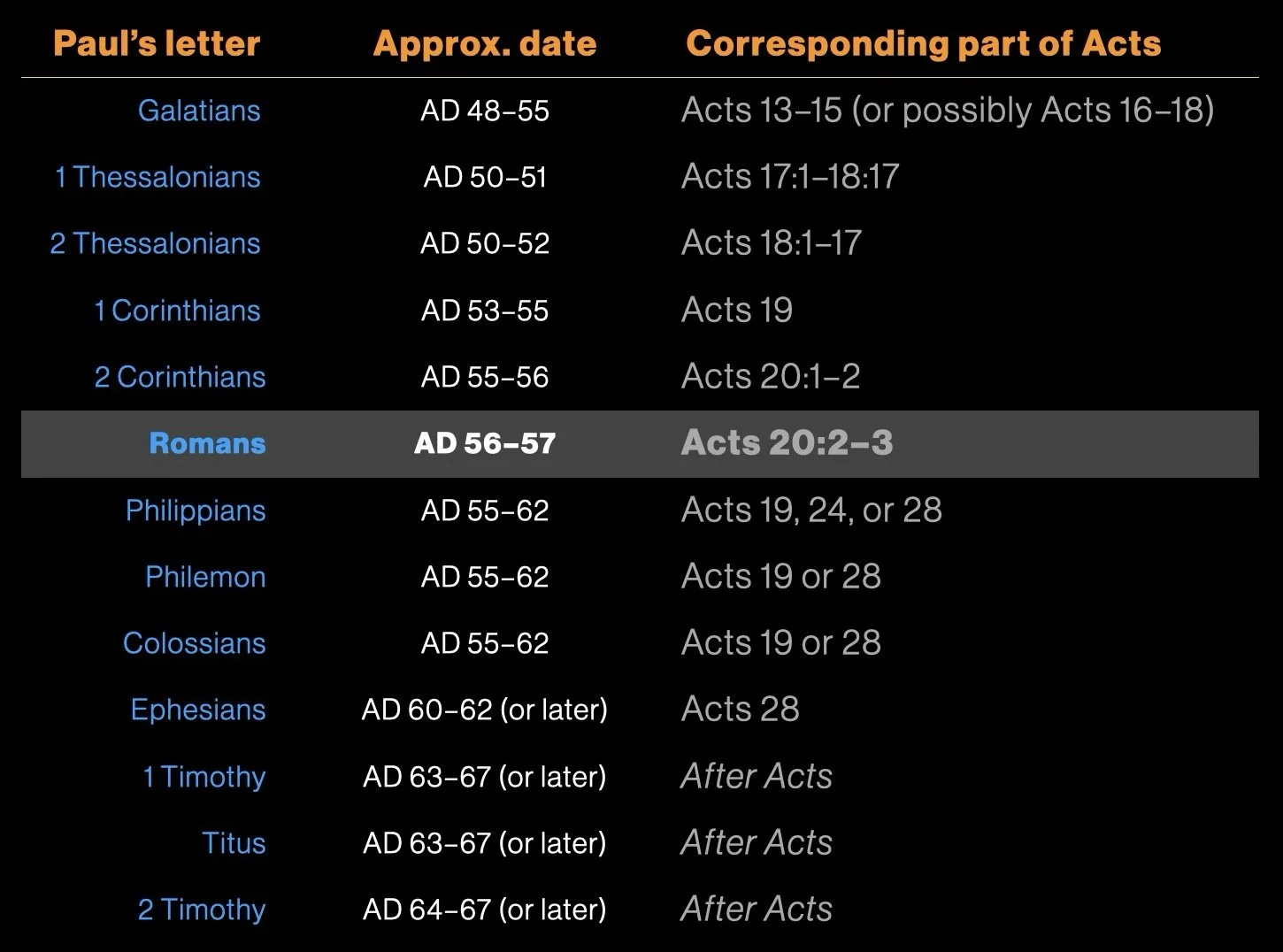
Remember our exercise at the start?
In our text today we see that there are at least 8 years of theological development in Paul and his letters are all about making sense of the simple tenet: Love God, love people, love self.
What does it mean to be in Christ’s community together when none of these is practically easy?
And when I read the letter to the Romans like this I see a mind at work trying to tie so many loose ends together it makes my head hurt. The intention of this letter is not to provide an accurate system of theology (even though it does a pretty good job at that).
It’s to help the church in Rome resolve how to live and love well together. If we steer the letter away from prioritising select verses and back into more of a whole, it is no longer tying strict doctrinal knots. Instead it’s holding all the strands together like a balloon salesperson in a park holding the strings. This clump of ideas, held at the bottom by hands where ‘this seems to make sense in all this mess’.
In the centre of the letter, chapter 7 contains a strangely honest confession about Paul’s inner workings. And I can bet you that he’s writing this not just because he alone thought it, but because these phrases and descriptions come out of a lot of pastoral conversations over the years. He identifies a struggle that many of us have today.
Now that I’m a Christ follower, I’m born of the Spirit—but how does it work that I still sin? (dehumanise others and self)
I feel as though he is a voltmeter constantly going between good angel and bad angel voices. Or perhaps less dualistically it could look something like this.
Voltmeters representing different virtues or Christian qualities
Here’s a summary of the his struggle:
I know what is good.
I even want what is good.
But I repeatedly fail to do it.
That means the problem is not ignorance or lack of desire.
The problem is a deeper bondage: something in me overpowers my best intentions.
Therefore I need rescue, not just better instructions.
His issue has been this tension I talked about earlier. The place of the Ancient Hebrew Law and the burden it has created. Conversely, if Christ has embodied and fulfilled that law on our behalf, then why do we not experience the freedom from it?
It’s not easy.
In chapter 8 he opens the question up from an individual struggle and into a community space.
‘You’ in these verses is a plural, ‘you all’. When we read it as singular the struggle is personalised and becomes and becomes an isolating, inner turmoil that Paul is trying to find context for. When it’s plural it becomes an absolution for us by the community.
What he says is a big deal. Romans 8 begins:
“There is no longer any condemnation for those who are in Christ Jesus. The law of the Spirit—the Spirit of life in Christ Jesus—has freed you [all] from the law of sin and death.”
Perhaps overstating it, but we have been freed from the deathly nihilism of our skin bags. All the anti-loving urges that our dopamine receptors like so much will perish and fade away—a simple mind-body paradigm can only point in that direction.
He goes on to say this:
“But you [all] are not in the flesh; you are in the Spirit, since the Spirit of God dwells in you [all].”
When we follow Jesus as the Christ, then we become part of a collective that’s oriented toward life in the Spirit.
What does this mean then?
The project here is not purity. Perfection judges and condemns imperfection. The superlatives are always unattainable as they are beyond our reach except as abstract ideas.
Instead we reckon differently at the fault lines, the chasms that open between us, the offences, the dissatisfactions, the disagreements—the mess of community. And we ask Where is love exercised most?
And we do that together, not in isolation, but with the higher order in our lives of living in the Spirit where our direction is toward this loving ideal, not away from it.
Love God, love people, love self. We’re better to do this together than apart.